

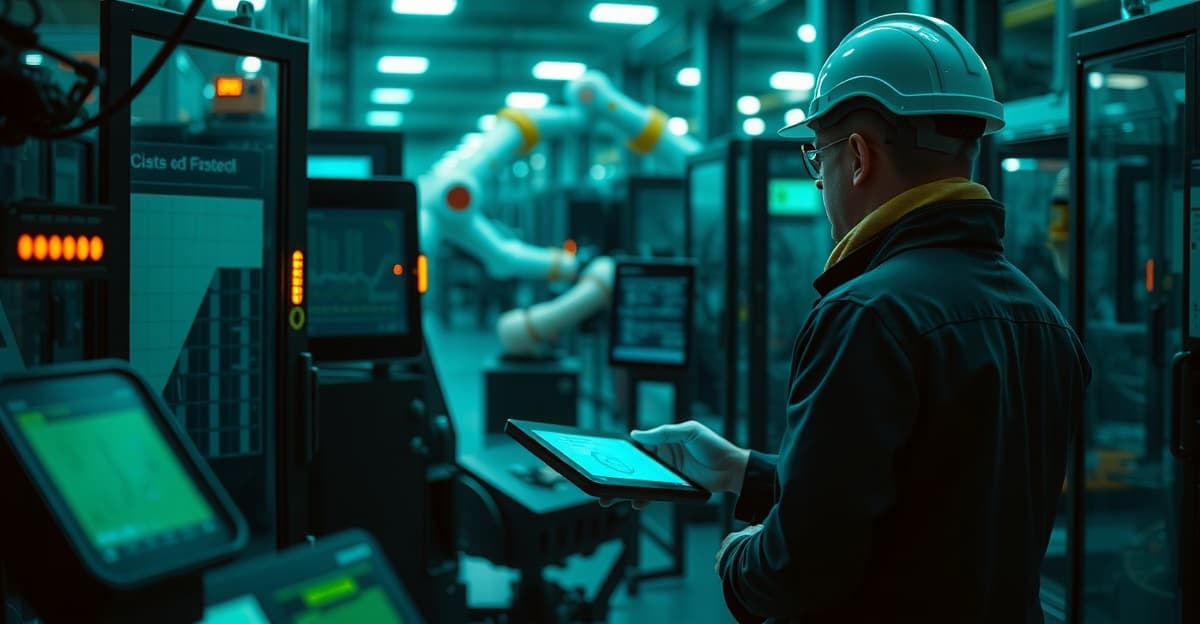
Discover how AI-powered training transforms manufacturing operations with measurable ROI. Learn frameworks, step-by-step implementation, and real cases of OEE improvement through smart factory learning.
Your production line just implemented a new MES system. Three months later, operators are still calling supervisors before each setup change, and your OEE hasn't budged from 62%. Sound familiar?
The gap between digital transformation investments and actual workforce capability is costing manufacturing companies millions. While Industry 4.0 technologies promise efficiency gains, 70% of initiatives fail—not due to technological limitations, but because the workforce isn't prepared to operate in this new environment.
This isn't about adding more training hours. It's about fundamentally rethinking how knowledge connects to action on the shopfloor, where every minute of unplanned downtime costs $22,000 in general manufacturing and $50,000 in automotive.
Traditional manufacturing training was built for static processes. Classroom sessions, printed manuals, and annual recertifications worked when production lines stayed unchanged for years. But in smart factories, where IoT sensors generate real-time data and production parameters shift dynamically, this approach creates dangerous knowledge gaps.
Industry 4.0 training represents a fundamental shift: from transferring information to developing adaptive workforce capabilities. It integrates artificial intelligence and learning technologies with manufacturing execution systems (MES), SCADA, and IoT infrastructure to deliver contextual, just-in-time knowledge at the point of need.
The difference is measurable. According to McKinsey Global Institute, the average manufacturing OEE globally sits at just 60%, with potential to reach 85% through adequate workforce development. That 25-point gap represents millions in lost productivity—much of it attributable to knowledge gaps that persist despite existing training programs.
Consider this scenario: An operator approaches a machine displaying an unfamiliar error code. In traditional training, they'd either guess, ask a supervisor, or consult a thick manual. In Industry 4.0 training, their tablet automatically displays the specific troubleshooting procedure triggered by the machine's IoT data, complete with contextual video and validation checkpoints.
This isn't just efficiency—it's a complete reimagining of how human expertise scales across complex manufacturing operations.
Manufacturing leaders need a structured approach to evaluate when AI training implementation will deliver measurable operational improvements. The decision isn't about technology readiness—it's about identifying scenarios where intelligent training can solve specific business problems.
OEE Below 65%: When Overall Equipment Effectiveness consistently underperforms industry benchmarks, knowledge gaps are likely contributing factors. Manufacturers achieving OEE above 80% typically have systematic approaches to knowledge transfer that respond to real-time operational conditions.
Setup Times Exceeding 30 Minutes: Extended changeover periods often indicate procedural knowledge issues rather than equipment limitations. If setup requirements vary significantly by product mix or operator experience, contextual training can deliver immediate improvements.
Recurring Quality and Safety Issues: When root cause analysis repeatedly identifies "operator error" or "procedure not followed," the actual problem is inadequate knowledge transfer. Pattern analysis of quality data helps identify specific procedures requiring intelligent training interventions.
New Technology Deployments: MES, ERP, or SCADA implementations create knowledge transfer challenges that traditional training can't address effectively. The complexity and customization of these systems require adaptive learning approaches.
Multi-Shift Operations: Facilities operating multiple shifts with varying experience levels benefit significantly from consistent, on-demand knowledge access. AI training ensures procedure standardization across shifts without requiring additional supervision.
High-Mix, Low-Volume Production: Complex product portfolios with frequent changeovers create knowledge management challenges that static training can't solve. Contextual training triggered by production schedules becomes essential.
Downtime Cost Analysis: Calculate the financial impact of knowledge-related downtime using industry benchmarks ($22,000-$50,000 per minute depending on sector). If monthly downtime costs exceed $500,000, AI training typically delivers positive ROI within 6-12 months.
Training Cost per Employee: When traditional training costs exceed $3,000 per employee annually (including lost production time), AI training often provides cost advantages while improving effectiveness.
Compliance and Safety Investment: Regulatory incidents, insurance premiums, and audit costs related to training inadequacies can justify AI implementation even without productivity improvements.
Digital System Integration: Existing MES, SCADA, or IoT infrastructure enables the contextual triggers that make AI training effective. Without system integration capability, benefits remain limited.
Mobile Device Readiness: Industrial tablet deployment or BYOD policies enable point-of-need content delivery. Training effectiveness drops significantly without mobile access in production environments.
Change Management Capability: Organizations with successful technology adoption track records are better positioned to implement AI training effectively. Cultural readiness for digital transformation is often more important than technical infrastructure.
Successful Industry 4.0 training implementation requires systematic integration with existing manufacturing systems. This isn't about replacing your production infrastructure—it's about making it intelligent enough to trigger learning at the right moment.
Start with data, not assumptions. Analyze downtime logs, quality reports, and safety incidents to identify knowledge gaps with measurable business impact. The framework should prioritize competencies based on:
A steel manufacturing client discovered that 40% of unplanned downtime traced to three specific procedures performed incorrectly. Rather than training all procedures equally, they focused AI development on these high-impact areas first.
Traditional Standard Operating Procedures (SOPs) assume static conditions. Industry 4.0 requires dynamic procedures that adapt to real-time production context. This transformation involves:
Contextual Content Creation: Break procedures into micro-modules triggered by specific machine states or production conditions. Instead of a 50-page manual, create 3-minute video modules activated by IoT sensor data.
Interactive Validation: Build checkpoints that verify understanding before allowing procedure execution. One chemical manufacturer reduced process deviations by 60% using validation gates that required operators to demonstrate competency before accessing equipment controls.
Continuous Content Updates: Connect content management to production data so procedures automatically reflect current equipment configurations, recent modifications, or seasonal operational changes.
The power of Industry 4.0 training comes from seamless integration with existing production systems. This requires API connections between training platforms and:
MES Integration: Trigger training based on production schedules, changeover requirements, or quality alerts. When the MES schedules a new product run, relevant operators automatically receive specific training modules.
SCADA Connectivity: Use real-time machine data to activate contextual learning. Machine temperature anomalies trigger thermal management training; vibration alerts activate predictive maintenance procedures.
IoT Sensor Networks: Connect environmental and equipment sensors to safety and operational training. High noise levels trigger hearing protection reminders; chemical concentration changes activate specific handling procedures.
The key is making training feel like a natural extension of the production system, not an interruption to it.
Training delivery must match the industrial environment's demands. This means ruggedized tablets, reliable offline capability, and interfaces designed for operators wearing gloves or working in low-light conditions.
Device Strategy: Deploy industrial tablets at workstations with content cached locally for offline access. Ensure compatibility with personal protective equipment and industrial cleaning procedures.
User Experience Design: Optimize interfaces for quick access during production. Average interaction time should be under 2 minutes for procedural training, 5-7 minutes for skill development modules.
Multi-Modal Content: Combine video, audio, and haptic feedback for noisy industrial environments where visual-only training fails.
Success metrics must connect training completion to business results. Traditional learning analytics (completion rates, quiz scores) don't predict operational improvement. Instead, track:
OEE Correlation: Measure OEE improvement in areas where specific training modules were completed vs. control areas.
First Pass Yield: Track quality improvements following training on specific procedures or equipment.
Setup Time Reduction: Monitor changeover efficiency before and after implementing contextual training for specific equipment configurations.
Safety Incident Reduction: Correlate safety training completion with incident frequency and severity in specific operational areas.
A multinational automotive client implemented this measurement framework and documented 15% OEE improvement within 90 days of deploying AI training for their most critical production lines.
The GTDI framework (Gestão, Transformação, Distribuição, Insights) provides a systematic approach to implementing Knowledge to Action principles in manufacturing environments.
Gestão (Management): Organize existing technical knowledge—manuals, troubleshooting guides, safety procedures—into structured, searchable databases connected to equipment and process identifiers.
Transformação (Transformation): Use AI to convert static documentation into adaptive, contextual learning experiences triggered by real production conditions and optimized for industrial environments.
Distribuição (Distribution): Deploy content through industrial mobile infrastructure integrated with MES, SCADA, and IoT systems for just-in-time delivery at the point of need.
Insights: Generate actionable intelligence by correlating training engagement with operational metrics like OEE, quality indicators, and safety performance.
This isn't theoretical—it's the systematic approach that enabled an automotive manufacturer to achieve 40% setup time reduction and a steel producer to improve OEE by 15% within their first implementation quarter.
For manufacturers looking to understand how Knowledge to Action frameworks apply specifically to industrial operations, the key is connecting each GTDI pillar to measurable production outcomes.
Even well-intentioned Industry 4.0 training initiatives fail predictably. Understanding these failure patterns helps manufacturers avoid expensive false starts.
The most common failure: purchasing advanced training technology without preparing the workforce for adoption. Operators who've relied on tribal knowledge for decades won't automatically embrace digital procedures, regardless of technical sophistication.
What goes wrong: Low adoption rates, resistance from experienced workers, and training systems that become expensive digital shelf-ware.
Prevention strategy: Implement change management programs with local champions—respected technical experts who demonstrate the technology's benefits through real problem-solving scenarios. Start with new procedures rather than replacing established workflows.
Training that exists in isolation from manufacturing systems feels irrelevant to operators dealing with real-time production pressures. If training doesn't connect to actual equipment states and production contexts, adoption remains low.
What goes wrong: Training content becomes outdated quickly, operators can't find relevant information when needed, and the system provides generic rather than contextual guidance.
Prevention strategy: Require API integrations with MES, SCADA, and IoT systems from day one. Training should feel like an intelligent extension of production systems, not a separate application.
Many manufacturers train supervisors and expect them to cascade knowledge to line operators. This approach fails in Industry 4.0 environments where information changes rapidly and context-specific knowledge can't be effectively communicated through verbal briefings.
What goes wrong: Knowledge gaps persist at the operator level where they directly impact production, and supervisors become bottlenecks for information access.
Prevention strategy: Implement multi-level training that reaches operators directly with role-specific content while providing supervisors with oversight and progress tracking capabilities.
Measuring training success through completion rates, quiz scores, or user satisfaction provides no insight into operational impact. These metrics can show high scores while production problems persist.
What goes wrong: Inability to demonstrate ROI, continued operational issues despite "successful" training programs, and loss of stakeholder support for training investments.
Prevention strategy: Establish operational KPIs (OEE, setup time, quality metrics) as primary success measures from program inception. Learning metrics should be leading indicators of operational improvement, not end goals.
The Evous platform transforms technical knowledge into measurable manufacturing results through AI-powered content adaptation and native integration with industrial systems. Unlike generic learning management systems, Evous was designed specifically for operational environments where knowledge gaps have immediate business consequences.
A multinational automotive client faced setup times averaging 45 minutes across their production lines—well above industry benchmarks. Traditional training provided generic procedures, but actual setup requirements varied based on equipment configuration, product specifications, and operator experience.
Evous implemented contextual training triggered by IoT sensors detecting machine state changes. When equipment prepared for reconfiguration, relevant operators received specific video procedures optimized for their experience level and the exact setup requirements.
Results achieved:
The system learned from each setup event, identifying which procedural steps caused delays and automatically updating training content. This created a continuous improvement loop where training effectiveness increased over time.
A major steel manufacturing group struggled with OEE performance that plateaued despite significant equipment investments. Analysis revealed knowledge gaps in optimal operating parameters that varied by steel grade, environmental conditions, and equipment wear patterns.
Rather than periodic retraining, Evous deployed just-in-time learning triggered automatically by MES data. When production parameters indicated suboptimal performance, operators received specific guidance on adjustments based on current conditions. The system integrated with SCADA to ensure recommendations matched real-time equipment states.
Results achieved:
More importantly, the improvement sustained over time as the system continuously updated guidance based on production performance data.
A chemical industry client experienced recurring safety incidents despite comprehensive traditional training programs. Investigation showed that safety procedures were properly understood but not consistently applied under varying operational conditions.
Evous implemented context-triggered safety training that activated specific procedures based on environmental sensors, chemical handling requirements, and operational risk factors. When conditions indicated elevated risk, relevant safety guidance appeared automatically on operator devices with validation requirements before proceeding.
Results achieved:
The system's ability to document procedural compliance through integrated verification also streamlined audit processes and reduced administrative overhead.
These results followed systematic application of the GTDI framework with manufacturing-specific adaptations:
For manufacturing leaders evaluating AI-powered training solutions, the key differentiator isn't the AI technology itself—it's the systematic connection between knowledge transfer and operational results.
Integration happens through standard APIs and pre-built connectors for major MES/ERP platforms including SAP, Oracle, Wonderware, and Rockwell. The approach doesn't require replacing existing infrastructure—instead, it adds intelligent training triggers based on system events.
Most implementations use REST APIs to connect training platforms with production systems. When the MES schedules a changeover, triggers relevant training modules. When SCADA detects equipment anomalies, activates troubleshooting procedures. When IoT sensors indicate environmental changes, delivers contextual safety guidance.
The integration typically takes 4-6 weeks for standard systems, with custom integrations requiring 8-12 weeks depending on legacy system complexity.
Based on Deloitte's 2024 Industry 4.0 Survey, companies implementing advanced digital training report ROI of 300-400% compared to 150% from traditional programs. Typical payback periods range from 8-14 months when measuring OEE improvement, setup time reduction, and quality enhancement.
Specific ROI drivers include:
ROI calculation should focus on operational improvements, not training cost savings. The investment typically pays for itself through production efficiency gains within the first year.
Resistance typically stems from fear that digital systems will replace human expertise or make jobs more complicated. Successful implementations address this through:
Start with enhancement, not replacement: Introduce AI training for new procedures or equipment rather than changing established workflows. Show how the technology makes experienced operators more effective, not obsolete.
Leverage technical leaders: Identify respected operators who become early adopters and demonstrate practical benefits. Peer influence overcomes management mandates.
Demonstrate personal benefits: Show how AI training reduces frustrating aspects of their work—fewer interruptions from questions, less time searching for information, reduced risk of mistakes that create rework.
Gradual implementation: Begin with voluntary adoption for non-critical procedures, expanding based on positive experiences rather than mandates.
One automotive client achieved 90% adoption within six months by starting with voluntary use for new product procedures, then expanding based on user requests for additional capabilities.
Yes, properly implemented AI training platforms exceed traditional compliance requirements. Certified platforms follow ISO 45001 and IEC 62443 standards with enhanced capabilities including:
Complete audit trails: Digital tracking of who accessed what training content, when, and with what validation results. This documentation often exceeds paper-based records for regulatory compliance.
Expert validation workflows: Content created by AI is reviewed and approved by qualified subject matter experts before deployment, maintaining human oversight while accelerating content development.
Integration with safety management systems: Direct connection to incident reporting, risk assessments, and corrective action tracking provides comprehensive compliance documentation.
Real-time competency validation: Unlike periodic recertification, AI systems can validate competency at the point of task execution, ensuring current knowledge rather than historical certification.
Many manufacturers find AI training improves compliance posture compared to traditional methods while reducing administrative overhead.
Global scalability is one of AI training's key advantages over traditional approaches. Cloud-based architectures enable:
Content localization: Automatic translation and cultural adaptation while maintaining technical accuracy and safety requirements. Regional regulatory differences are incorporated automatically.
Standardized templates with local adaptation: Global procedures maintain consistency while accommodating local equipment variations, supplier differences, and regulatory requirements.
Centralized governance with distributed execution: Corporate standards and compliance requirements are maintained globally while plant-level implementation accounts for local operational differences.
Performance benchmarking: Compare training effectiveness and operational impact across facilities to identify best practices and improvement opportunities.
A chemical multinational deployed AI training across 15 facilities in 8 countries within 6 months, achieving consistent safety and quality improvements while accommodating local operational requirements.
The scalability advantage becomes crucial for manufacturers operating multiple facilities where consistent knowledge transfer directly impacts operational performance and regulatory compliance.
Ready to identify knowledge gaps impacting your manufacturing performance? Understand how AI-powered training could improve your specific OEE, setup times, and safety metrics. Diagnóstico de gaps de treinamento Industry 4.0 (15 min) to evaluate the operational improvement potential for your facility within 90 days.
Tell us about your operation and we'll build the roadmap together.
Talk to our team